


Overview
State governments depend on information from the CDC’s Youth Risk Behavior Surveillance System, known as YRBSS, to detect and track concerning patterns in teen health issues. This data helps in crafting programs and policies to address these problems. In January 2025, YRBSS data was removed from public availability, along with numerous other federal datasets, due to unclear and scientifically questionable executive orders issued by President Trump. This action has created a critical gap in information right when educational institutions, public health organizations, and decision-makers require precise data the most.
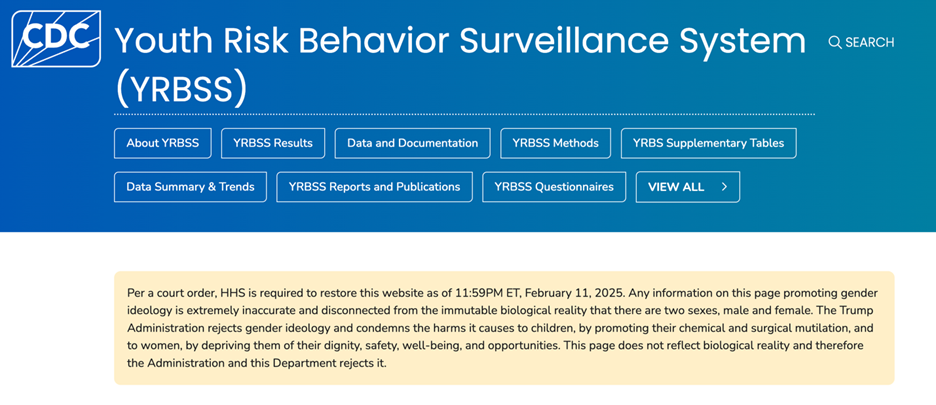
Figure 1. Screenshot of the Youth Risk Behavior Surveillance System (YRBSS) Website as of August 28, 2025
Throughout the United States, local areas are facing a dramatic increase in mental health difficulties among young people, instances of self-injury, suicide rates, and bullying occurrences. Over the ten years before the COVID-19 outbreak, rates of ongoing sadness, despair, and thoughts of suicide in teenagers surged by roughly 40 percent. The pandemic worsened this situation considerably, heightening feelings of isolation, interrupting schooling and social interactions, and exacerbating challenges like unstable housing and food shortages.
CDC reports from 2021 to 2023 indicated slight positive shifts, for instance, the proportion of students reporting persistent hopelessness or sadness dropped from 42 percent to 40 percent. Nevertheless, current teen mental health figures are still markedly poorer compared to those from a decade earlier. Notable differences continue to exist, especially impacting girls and LGBTQ+ adolescents. With solid understanding of the extent and characteristics of mental and behavioral health issues affecting youth, leaders in policy, education, healthcare, and families can implement impactful strategies to assist young individuals.
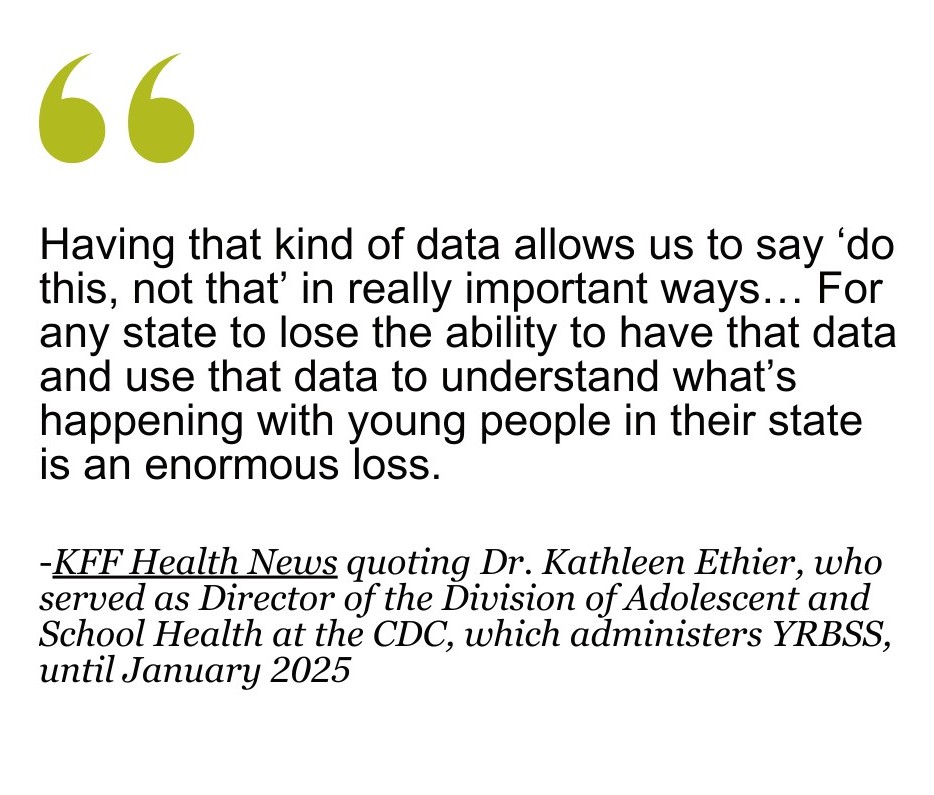
These issues demand immediate attention, yet the vital data used to comprehend and tackle them is progressively vanishing.
For over 30 years, the CDC’s Youth Risk Behavior Surveillance System has been fundamental in monitoring primary causes of mortality and injuries in youth populations. This anonymous survey, conducted nationally with additional state and local versions, releases findings biennially. It offers crucial perspectives on students’ encounters with depression, substance use including alcohol and drugs, experiences of bullying, sexual wellness, nutrition habits, exercise levels, sleep patterns, and other factors. These insights guide decisions on public health and education budgets at the state level, as well as community-based prevention initiatives.
Governments at the state level use YRBSS data to pinpoint and observe negative developments in young people’s health, enabling the creation of targeted programs and policy measures. For instance, Utah’s health department utilized YRBSS results to create the SafeUT mobile application and the Live On suicide prevention initiative. This effort was mandated by state legislation in 2019 and rolled out in 2020. Although suicide remains the top cause of death for Utah youth aged 10 to 24, intentional self-harm deaths among teens aged 15 to 19 declined from 2017 to 2022.
Connecticut gained permission to include a question on disabilities in its state YRBSS section. Consequently, they discovered that students with Individualized Education Program plans faced higher risks of bullying, cyberbullying, and substance use. Such targeted demographic information proves invaluable for shaping relevant programs and support systems.
On January 31, 2025, YRBSS datasets joined other federal resources in being withdrawn from public view. This stemmed from executive orders by President Trump targeting the elimination of gender ideology and diversity, equity, and inclusion initiatives in data, research, policies, and messaging. State and local authorities, reliant on federal data for essential operations ranging from emergency responses to city planning, now find themselves severely hampered.
Subsequently, on February 11, 2025, a federal court mandated that the CDC and related agencies reinstate datasets and web pages to their status as of January 30, 2025. Currently, the YRBSS site displays a prominent notice claiming that decades of research data are highly inaccurate. It also presents an unusual presidential scientific assertion that oversimplifies complex matters and lacks broad support within the scientific field.
It seems YRBSS will permit states to tailor their survey sections, potentially adding gender identity questions. Although essential for tracking youth health domains no longer addressed at the national level, this prevents reliable comparisons across states or nationally. Consequently, inequities for LGBTQ+ youth and other vulnerable groups may endure or intensify in regions aligning with the administration’s directives.
Removing key public health data represents merely one element of a broader, seemingly illogical campaign against federal scientific frameworks that researchers and state health officials depend on to observe and counteract health threats facing Americans.
Recent developments include arguments from lawyers representing CDC director Dr. Susan Monarez, who contended that her removal was legally flawed and indicative of deeper issues like the suppression and politicization of scientific work. They highlighted a systematic breakdown of public health bodies, expert silencing, and the hazardous infusion of politics into science. A May 2025 article in Science magazine emphasized that federal science thrives due to expert agency staff committed to top-tier output, but political interference undermines statutory scientific duties.
Certain states are stepping up by expanding behavioral health assessments and partnering beyond federal sources to combat the teen mental health emergency. In July 2025, Illinois enacted legislation mandating yearly mental health evaluations for students in grades 3 through 12 starting in 2027. Six states—Alabama, Hawaii, Kentucky, New Jersey, Oklahoma, and Virginia—joined a National Governors Association effort for technical aid and reforms in youth mental health frameworks. Additionally, eleven states including Colorado, Michigan, Minnesota, California, Iowa, Maryland, New Jersey, New York, Virginia, and Utah engaged in an AmeriCorps initiative to prepare and deploy mental health peer specialists and navigators within schools.
Conversely, some states have worsened federal limitations by exiting the YRBSS, even prior to national changes, enacting rules demanding active parental approval for student survey involvement, or launching their own experimental state-level youth risk assessments. Federal regulations since 1974 necessitate parental notification and opt-out options for school surveys touching sensitive topics like mental health and sexual conduct.
Moreover, the methodological strength of these emerging state surveys remains questionable. Florida, for example, departed from YRBSS in 2022 absent any legislative basis or rationale. Unlike YRBSS, which underwent years of development with rigorous validity checks, Florida’s alternative survey was hastily produced in six months lacking openness, per the Florida Policy Institute.
Imposed constraints at federal and state levels on public health information threaten data integrity, ongoing tracking, and cross-jurisdictional alignment. This leads to overlooked alerts, suboptimal responses, and avoidable injuries. Such information voids emerge at a pivotal time when educators, health bodies, and policymakers crave dependable facts. Congress-approved, publicly supported health monitoring systems demand restoration and safeguarding to preserve scientific standards and agreement, regardless of political or ideological opposition. When ideology supplants data and mutes science, we forfeit not only figures but the capacity to protect youth mental well-being, security, and prospects—as they rely on our clear vision.