

Poverty Point Mounds: Purpose Revealed
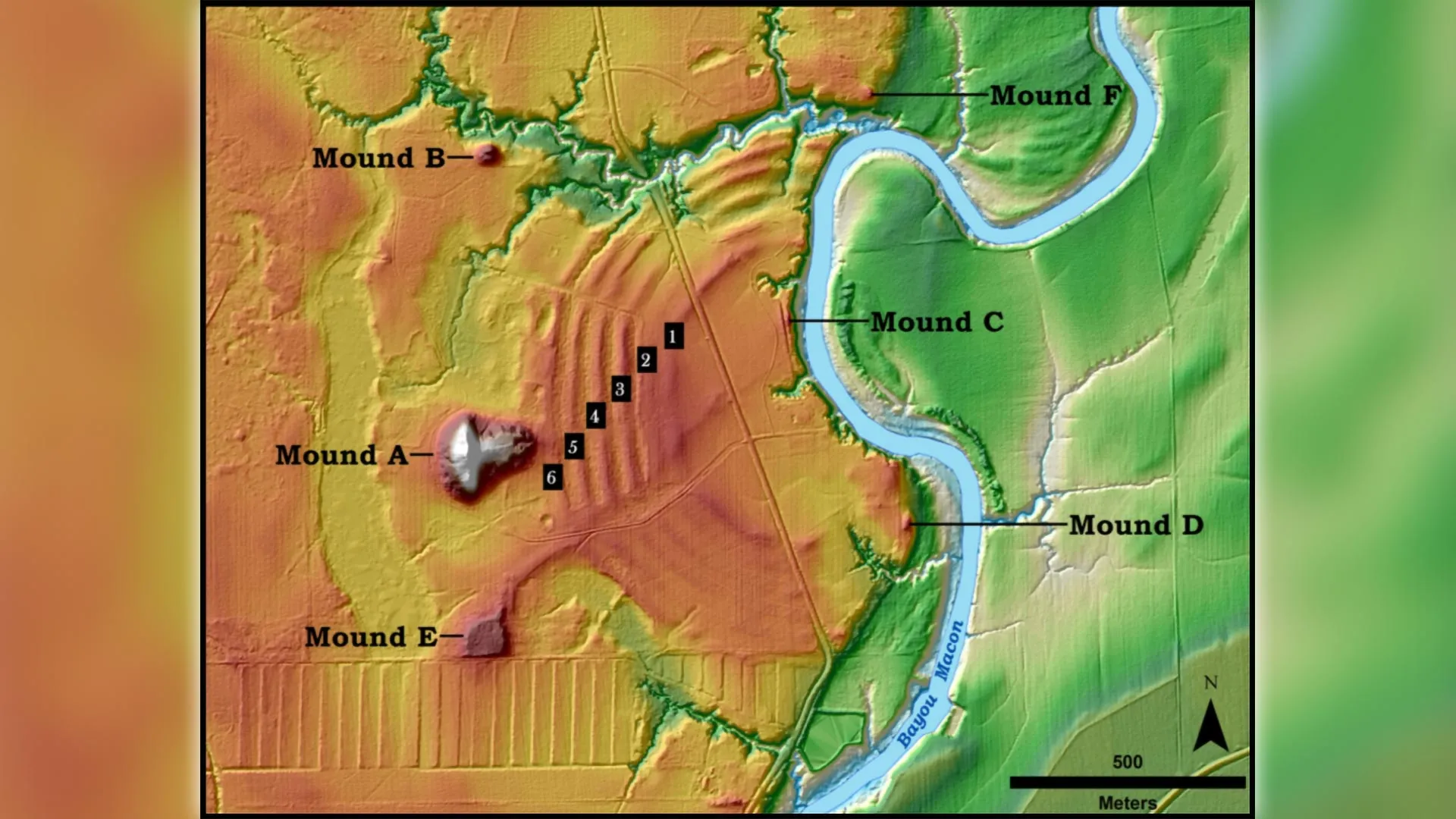
Approximately 3,500 years ago, hunter-gatherer groups started constructing vast earthen mounds along the Mississippi River at Poverty Point, a UNESCO World Heritage Site located in northeast Louisiana. Tristram ‘T.R.’ Kidder, the Edward S. and Tedi Macias Professor of anthropology, characterizes the magnitude of this project by stating: ‘They transported at least 140,000 dump truck loads of soil, entirely without the aid of horses or wheels. This demanded tremendous labor. The central puzzle remains: what drove them to do it?’
Kidder and his research team from Arts & Sciences at Washington University in St. Louis revisited Poverty Point and adjacent sites to gather fresh radiocarbon dates and reassess existing archaeological materials. Their latest investigations are challenging traditional understandings of how these prehistoric societies operated.
Kidder outlined these discoveries in two recent papers published in Southeastern Archaeology, co-authored with graduate student Olivia Baumgartel and Seth Grooms, a 2023 PhD graduate from WashU now teaching at Appalachian State University.
Signs of Extensive Trade Networks
Poverty Point is renowned for its enormous mounds, which are still prominent in the landscape today. However, the smaller artifacts discovered there reveal an even more remarkable narrative. Excavations have yielded thousands of fired clay cooking balls along with resources transported from distant locales, including quartz crystal from Arkansas, soapstone from the Atlanta region, and copper items sourced near the Great Lakes. ‘These individuals engaged in long-distance trade and travel,’ Kidder observed.
For decades, experts assumed that building Poverty Point necessitated a rigidly hierarchical society laboring over multiple generations. Since the later Cahokia Mounds in present-day Illinois were built under a chiefdom system, scholars presumed a similar organization at Poverty Point. Nevertheless, Kidder cautions that the most straightforward assumption isn’t necessarily accurate.
Redefining Social Dynamics
In their newest paper, Kidder and Grooms present an alternative perspective on Poverty Point. They argue it was not a fixed settlement governed by authoritative leaders directing workers, but rather a grand assembly point where people from the Southeast and Midwest convened seasonally for trading, festivities, cooperation, and collective ceremonies.
These concepts build upon hypotheses that Kidder and his students have refined over time. Drawing from the evidence, they picture a society bonded by shared objectives. As Baumgartel noted, ‘Our view is that these were egalitarian hunter-gatherers, free from domination by any elite chiefdom.’
Kidder further contends that the earthworks show no signs of glorifying powerful figures. Instead, he sees them as a communal endeavor spanning a few years, aimed at exerting influence over an unpredictable environment. ‘During the construction period, the Southeast endured extreme weather events and devastating floods,’ he explained. ‘We propose that Poverty Point’s visitors erected the mounds, conducted rituals, and deposited precious items as offerings to restore spiritual balance.’
A Sacred Site, Not a Village
Kidder and Grooms highlight the absence of burials or indications of permanent dwellings at Poverty Point. ‘Such features would be expected in a long-term community,’ Kidder remarked. ‘The notion of continuous habitation for centuries is no longer sustainable; a revised model was essential.’
While spiritual practices rarely produce tangible remnants like ceramics or implements, Kidder and Grooms offer strong indications of profound ceremonial significance. ‘I have had extensive discussions with Native American descendants,’ Kidder shared, adding that Grooms belongs to the Lumbee tribe of North Carolina.
These dialogues have bolstered their conviction that Poverty Point gatherings were driven by sacred imperatives incompatible with contemporary notions of economic profit. ‘Archaeologists must embrace diverse worldviews,’ Kidder emphasized. ‘Western perspectives often assume such extensive travel and toil must yield material benefits. Instead, we interpret it as a profound ethical duty to mend a fractured cosmos.’
Distinct Regional Timelines
Poverty Point was one of several prominent assembly locations in the area. Washington University researchers are also studying Claiborne and Cedarland, two sites in western Mississippi that hosted similar artifact assemblages. Unfortunately, both have suffered from modern development and looting by collectors. ‘In modern archaeology, we frequently follow in the wake of destruction,’ Kidder lamented.
To minimize further disruption, the team used radiocarbon analysis on clam shells and deer bones gathered decades ago. The findings indicate Cedarland predated Claiborne and Poverty Point by about 500 years, establishing unique chronologies. ‘We have disentangled these sites, assigned them separate histories, and begun tracing the regional flow of artifacts,’ Baumgartel summarized.
Ongoing Research Efforts
This meticulous methodology persists at Poverty Point. In May and June of this year, Kidder and Baumgartel resumed digging test pits originally opened in the 1970s. Employing contemporary radiocarbon methods and sophisticated microscopy, they seek insights beyond the reach of past studies.
‘Olivia and I sifted through minuscule quantities of earth in sweltering heat—it was exhausting,’ Kidder recalled. ‘Reflecting on the colossal exertion by Poverty Point’s builders remains profoundly motivating.’ New radiocarbon data and reexamined artifacts suggest far-flung travelers met to trade, worship, and participate in rituals designed to appease the forces of nature.